


Table of contents
Moving to Calgary means discovering not just a new city, but a collection of unique mini regions, each with its own character, rhythm, and way of life. While a Calgary community map might look like a simple quadrant layout at first glance, locals know that each quadrant feels like its own village. Families here don’t just live in Calgary, they proudly live in the Northwest, Southwest, Southeast or Northeast, and that identity becomes part of daily life, school routines, weekend activities, and even sports travel.
Choosing where to call home in Calgary isn’t only about house style or price. It’s about commutes, school pathways, sports commitments, lifestyle priorities, and even weather patterns. When you understand how Calgary is shaped and how each area functions, it becomes far easier to pick a neighbourhood that truly fits how you live.
Use the provided interactive map to explore communities in each quadrant of the city. Filter by community features to shorten the directory on the right, or click on an individual community for more information as well as access to active listings.
Understanding the Calgary Quadrants
Calgary is divided into four main sections: Northwest, Southwest, Southeast and Northeast. Each one offers something distinct, from access to the mountains to multicultural food districts, established school networks to brand new master planned communities.
Beyond geography, Calgary’s quadrants hold meaning. Ask a local where they live and watch how confidently they reply. People here feel strongly connected to their corner of the city, and in many ways, each one operates like its own community ecosystem.
Let’s take a closer look, quadrant by quadrant.
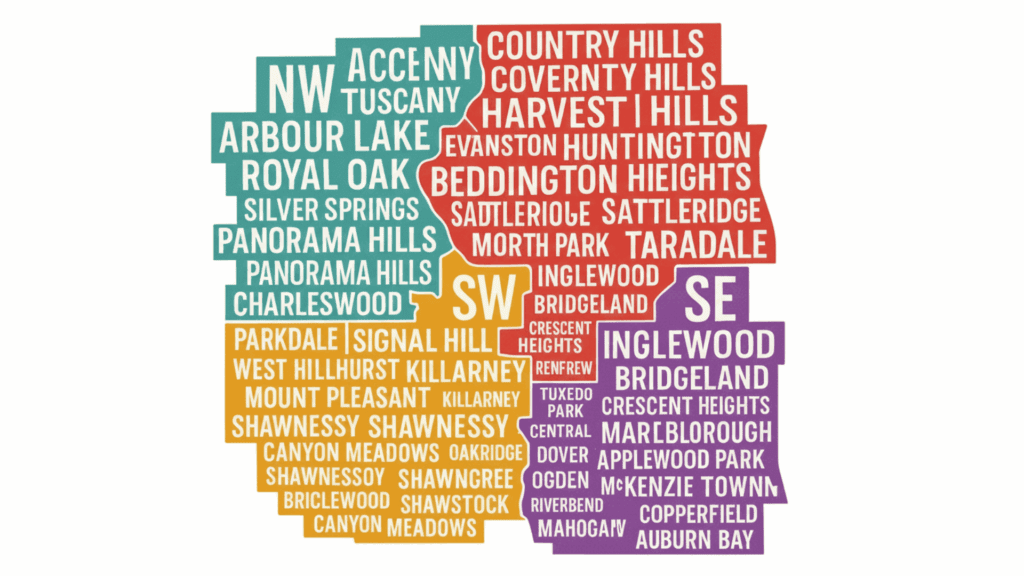
Southwest Calgary (SW)
Lifestyle: established, scenic, and close to the mountains
Best for: outdoor lovers, professionals working downtown, families valuing established schools
The SW quadrant is often the first choice for those who want proximity to the Rocky Mountains. Whether you are skiing in winter or hiking at Kananaskis in summer, the west and southwest portions of the city provide the quickest road out of town for mountain adventures. Mature communities, strong school reputation areas, and elegant tree lined streets define many SW neighbourhoods.
Commuting from the SW into downtown tends to be convenient, particularly along 17th Ave SW, Bow Trail, and via the C-Train West Line. Families involved in western side sports programs (like hockey arenas in West Springs or equestrian facilities west of Calgary) often choose SW for ease of travel.
The farther west you go, the more you’ll notice gentle elevation. On windy winter days, exposure to Chinook winds warms the city from the foothills nearby. Many new developments continue pushing westward, meaning those exploring a southwest Calgary map today will find both character neighbourhoods and high end modern builds.
Southeast Calgary (SE)
Lifestyle: lake communities, new master planned neighbourhoods, space to grow
Best for: families wanting newer homes, lake recreation, and access to future focused amenities
The SE quadrant has transformed rapidly in recent years. Neighbourhoods like Mahogany, Auburn Bay, and Cranston have become some of Calgary’s most desirable for families thanks to lake access, new schools, and proximity to medical and recreation hubs like South Health Campus and the YMCA at Seton.
Families involved in baseball or ringette often choose the SE because it provides shorter routes to sports complexes in south Calgary and even Okotoks. (If you have kids training south of the city, this quadrant can save a lot of driving time!)
Homes tend to be newer, community design emphasizes pathways and ponds, and retail and medical services continue expanding. Many newcomers find SE life vibrant and accessible, especially if they’re working in health care, engineering, or tech near Quarry Park or Seton.
Northwest Calgary (NW)
Lifestyle: views, access to nature, established schools
Best for: outdoor families, university employees, those wanting established communities and transit
The NW quadrant blends older established neighbourhoods with newer family communities near the ring road. With quick access to the mountains along Highway 1 and the beauty of Nose Hill Park, NW remains a favourite for nature oriented families.
Proximity to the University of Calgary, Alberta Children’s Hospital, and Foothills Medical Centre makes it ideal for students and medical professionals. The C-Train line through this quadrant gives teens and commuters excellent independence.
However, newcomers should know that NW areas at higher elevation can experience more intense winter conditions. Colder wind chills, more snowfall, and occasional blowing snow are more common compared to central and south Calgary. If you dream of winter sports, it might feel perfect; if you dislike shoveling, choose streets and exposures wisely!
Northeast Calgary (NE)
Lifestyle: multicultural, vibrant food scene, evolving infrastructure
Best for: newcomers seeking diversity, affordability, transit convenience, and airport access
The NE quadrant is known for its rich cultural diversity and strong sense of community. From incredible South Asian, Middle Eastern, African, and Filipino food districts to places of worship and community centres, NE Calgary offers newcomers a sense of belonging and cultural continuity.
This part of the city has some of the best transit access, including the Blue Line C-Train, and quick routes to the airport, major distribution hubs, and logistics corridors. Many new developments continue toward the north and east, and Calgary’s shifting demographics have created naturally concentrated cultural hubs. For many, this creates comfort and connection; for others, it means exploring to find the right neighbourhood fit.
Weather note: The NE, like the NW, can feel more exposed to winter wind and cold due to prairie openness. Families moving here quickly learn the value of good winter tires and sturdy snow boots.
How to Choose the Right Quadrant for Your Family
Every quadrant shines in its own way, and one of the most helpful ways to approach Calgary’s layout is by imagining your daily rhythm. Think about where you will spend most of your time during the week, where your children will be going to school or activities, and what kind of lifestyle you picture when you think about home. Calgary is a city where convenience truly affects quality of life. The right quadrant should make your weekly routines feel easier, not harder, and the city’s diverse geography means that a small decision on where you live can significantly impact how you experience life here.
Below are some key considerations to help you navigate the Calgary community map and choose the best fit for your family.
1. Work Location
Calgary has multiple employment hubs, and rush-hour driving can add time depending on direction of travel and winter weather. For many families, living near the workplace of one or both adults can make a noticeable difference in work life balance. While reverse commuting is often smoother here than in other major cities, choosing a quadrant close to your main job centre can simplify mornings, give you precious extra time at home, and reduce stress on snowy days.
If your work is based in:
- Seton / South Health Campus → SE or deep south communities
- University of Calgary / Foothills Hospital → NW or west-central areas
- Downtown → Inner city, Kensington, Beltline, SW along C-Train corridor
- Airport / Logistics corridor → NE or north central communities
This isn’t a one-size-fits-all decision, but proximity to work, especially in winter, makes a meaningful difference for many Calgarians.
2. School Pathways
School catchments in Calgary are neighborhood-based, so your home address influences where your children attend school. If you have specific academic paths in mind, such as French Immersion, Catholic schooling, or access to specialized programs, it is worth reviewing school designations alongside your home search. Being near your designated schools can create consistency and independence for kids, especially once they begin walking, biking, or bussing on their own.
Considerations for school planning:
- French Immersion zones vary significantly by quadrant
- Catholic system has its own catchment structure
- Some neighbourhoods offer K–9 or K–12 continuity
- Specialized programs may require travel across the city
Parents relocating here often find that choosing a quadrant aligned with school goals reduces commuting stress and creates smoother daily routines.
3. Sports and Activities
Calgary is a very active city, and youth sports can shape weekly schedules just as much as school. If your family participates in competitive athletics, riding programs, or arts training, location matters. Choosing a home near your primary training facilities prevents hours of driving every week and allows your child to build community where they play.
Activity based guidance:
- Baseball academies, ringette hubs, and Okotoks Dawgs programs → South Calgary
- Equestrian and horse jumping facilities → North Calgary or beyond Airdrie
- Mountain sports enthusiasts → West or Northwest for fastest mountain access
- Figure skating, hockey, gymnastics → training centres exist across all quadrants
Families here often say, “your sport will choose your quadrant.” If your child trains regularly, plan your home base accordingly.
4. Transit Access & Commuting
Calgary’s commuter culture is evolving, with more families prioritizing transit access for both work and teens gaining independence. If you are moving from a larger city, you will notice Calgary’s road network is efficient and logical, especially with the completed ring road. Still, where you choose to live influences how easily you can get downtown, to universities, or to the airport.
Transit and road access factors:
- C-Train lines in NW, NE, and SW greatly improve commute ease
- Proximity to the ring road enables fast cross-city travel
- Bus Rapid Transit routes (MAX lines) serve major corridors
- Living near downtown is ideal for walkability and biking
This is especially helpful for families planning long term, as easy mobility lets teens participate more independently in their school and activities.
5. Housing Style & Community Feel
Each quadrant has its own flavour when it comes to neighbourhood character, architectural style, and community culture. The right choice comes down to lifestyle preference. Some families love the charm of older, tree-lined streets, while others appreciate the convenience and layout of newer master planned districts. Beyond the house itself, consider parks, playgrounds, walkability, and how people interact in the neighbourhood.
Lifestyle preferences may include:
- Modern lakeside communities → SE
- Acreages and equestrian proximity → North and NW outskirts
- Inner city character homes and walkability → SW and central
- Family oriented new builds with schools nearby → SE and SW
- Established schools and mature trees → NW and SW legacy communities
Choosing a community that fits your pace, personality, and family values will make settling into Calgary feel effortless.
The Calgary Community Identity
One thing newcomers love discovering is that Calgarians have quadrant pride. People feel deeply connected to where they live, shop, dine, and play, and that shared identity builds connection faster than many expect.
The city has also evolved significantly. Today, Calgary’s neighbourhoods reflect increased cultural diversity and multicultural clusters, giving families options to live near cultural hubs, schools, and services that feel familiar and supportive. This adds richness, flavour, and warmth to everyday living.
Final Thoughts
Exploring a Calgary neighborhood map is more than learning street names. It is about choosing a lifestyle. Consider where you will work, which schools support your family, where you play sports, and how often you plan to escape to the mountains.
Tour different areas. Visit parks and community centres. Drive your likely commute. Talk to a local Realtor. Picture your daily life, from school drop-offs to weekend adventures.
Calgary is a city where families thrive, community identity runs deep, and every quadrant has something special to offer. Wherever you land, you’ll quickly find your place, and your pride, in this welcoming, growing city.