


Real Estate Investment Strategies
Calgary’s real estate market has shifted. After several years of very strong seller’s market conditions, fast moving listings, multiple offers, and significant interprovincial migration, we are now seeing a more balanced and thoughtful market emerge.
For investors, that can actually be good news.
A calmer market often creates more room to pause, compare options, run the numbers, and look for properties with real long-term potential. Instead of feeling rushed into a bidding war, buyers may have a better opportunity to focus on value, location, rental demand, future growth, and the type of property that makes sense for their budget.
For budget conscious investors, Calgary continues to offer some compelling opportunities; especially when compared with larger and more expensive Canadian markets. The key is knowing where to look, what numbers matter, and which properties have the best chance of supporting your investment goals over time.
1. What Makes Real Estate Investment More Affordable in Calgary?
When we talk about affordability, it is important to look beyond the average home price. For investors, affordability also includes the cost of getting into the market, ongoing carrying costs, rental potential, and the ability to find properties that can generate income.
Compared with markets like Toronto and Vancouver, Calgary still offers a lower barrier to entry. While prices have increased in recent years, many investors are still able to find properties at price points that would be much harder to access in Canada’s largest coastal cities.
The Alberta Advantage
One of the biggest benefits of investing in Alberta is the lower cost of purchasing property. Alberta does not have a provincial sales tax, and buyers are not faced with the same high land transfer taxes found in some other provinces. This can make a meaningful difference when calculating your total cash required to close.
Calgary also offers a wide range of property types, from condos and townhomes to detached homes with suite potential, duplexes, and small scale multi-unit opportunities. For investors, that variety creates flexibility. Depending on your budget and goals, you may be able to choose between a lower maintenance rental property, a home with a legal secondary suite, or a longer term redevelopment opportunity.
The best opportunities are not always the flashiest homes or the cheapest listings. Often, they are the properties where the numbers make sense, the location supports strong rental demand, and there is a clear plan for how the property can perform over time.
Key 2026 Market Trends Influencing Pricing
The overriding theme is an ‘adjustment to higher supply.’ Local developers broke construction records over the last two years, and those purpose-built rentals and multi family completions are flooding the market. Concurrently, net migration has normalized from an explosive 3% down to a steady, sustainable 1.3%.
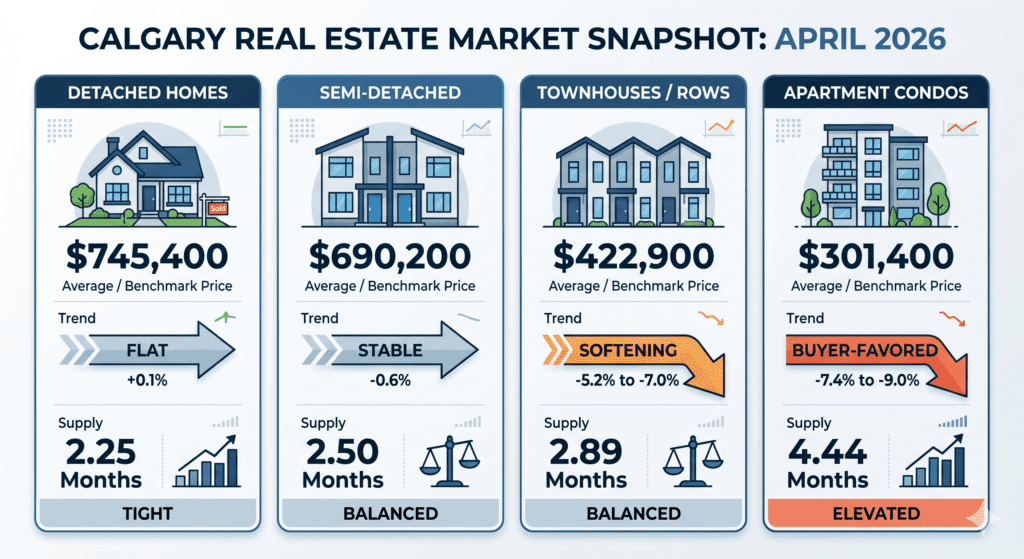
This combination of surging inventory and moderated demand has cooled price escalation. While detached homes remain a resilient, tight segment, segments like townhomes and apartment condominiums have faced healthy price corrections of 5% to 9% year over year. For the first time in a major housing cycle, buyers have genuine negotiating room.
Calgary Market Snapshot at a Glance
2. Top Strategies for Affordable Real Estate Investments
Succeeding in this market requires prioritizing math over momentum. With carrying costs influenced by stable but elevated mortgage rates (the lowest variable rates hover around 3.4% to 3.6%), properties rarely cash flow by accident. Budget conscious buyers must target specific structures and asset classes.
Strategy A: Capitalize on the Condo Market Correction
With apartment condo benchmarks dropping to around $301,400 and inventory climbing past 4 months of supply, the inner city (e.g., Beltline, Downtown Centre) is a prime counter cyclical playground.
- The Play: Target modern 1- or 2-bedroom units where sellers face heavy competition from brand new inventory. Negotiate aggressively on the purchase price, but prioritize buildings with historically well-managed, lower condo fees and strong structural integrity to safeguard your margins.
Strategy B: The Suited Property Blueprint (Dual Income Architecture)
One of the most defensive, affordable strategies involves purchasing single family or semi-detached properties in mature communities (such as North or Northeast quadrants) that are perfectly configured for a legal secondary suite. I am finding that there is an oversupply of basement suits in segments of the city, so it’s worth testing with a realtor given the current rental market.
- The Play: By ‘house hacking’ (living in one unit and renting out the other) or managing it purely as a dual income investment property, you collect two separate rents (e.g., a family upstairs, a single professional or student in the basement). This significantly offsets higher borrowing costs, accelerates principal paydown, and protects you against the hazard of a total building vacancy.
Strategy C: Suburban Townhomes in Master Planned Hubs
Townhouses bridge the gap between financial accessibility and tenant demand. Expanding master planned communities like Seton (near the South Health Campus employment node) and Tuscany offer high quality of life, amenities, and transit access.
- The Play: Snag townhomes at benchmarks around $425,000. These are highly attractive to young families and professionals priced out of detached homes. Because they face less direct competition from institutional purpose built rental high rises, townhomes maintain remarkably steady tenant retention rates.
3. Risks and Challenges of Investing in Calgary Real Estate
No investment landscape is without friction. Entering a rebalancing market means you must identify and mitigate downside risks immediately.
Risk 1: Rising Vacancy Rates and Rental Competition
Because roughly 45% of Calgary’s recent record-high housing starts were purpose-built rentals, the overall city vacancy rate has climbed from a historic low of 1.4% up toward 4.6% to 6.0% in certain quadrants. Landlords no longer hold all the cards; tenants have choices, and rent growth has slowed or flattened.
- Mitigation: Ensure your property stands out by keeping it impeccably maintained, and strictly buy within a 10-to-15-minute walk of major transit infrastructure (CTrain lines), hospitals, or post-secondary institutions (U of C, SAIT, MRU).
Risk 2: Sticky Carrying Costs and Optimistic Math
The single biggest mistake new investors make is using ‘rosy assumptions’; underestimating vacancies or overestimating market rents, to make an underwhelming property look good on a spreadsheet.
- Mitigation: Stress test your numbers manually. Model your property assuming a 6% vacancy rate and a 10% maintenance/capital expenditure reserve. If the cash flow metrics turn dangerously negative under stress testing, walk away from the deal. Real estate is a game of staying power, not a short-term race.
4. Expert Tips for New Investors in Calgary
To smoothly transition from an aspiring buyer to a successful property owner, adopt a systematic approach based on local expertise.
- Prioritize Unit Economics Over Aesthetics: Understand your true primary objective. If you seek strong current rental yields to build capital, prioritize suited properties and townhomes. If you seek long-term land value and capital appreciation, focus on detached homes in established areas and accept a flatter monthly cash flow today. Trying to get maximum appreciation, maximum cash flow, and minimum risk all in one property is a statistical myth.
- Monitor the Sales-to-New-Listings (S/NL) Ratio: Track hyper-local market metrics provided monthly by the Calgary Real Estate Board (CREB). When a specific neighborhood’s S/NL ratio drops below 50%, it indicates localized buyer leverage: meaning it’s time to submit opportunistic, lower than list offers.
- Engage a Local Unbiased Voice: Before writing an offer, have a specialized property management team perform a realistic rental appraisal. They have no incentive to exaggerate numbers to close a sale, giving you the cold, hard truths regarding what local tenants are actually willing to pay.
- Get Plugged Into Alberta Investment Networks: Do not isolate yourself. Join local real estate investor associations, attend networking events (such as the Real Estate Investment Network – REIN Alberta chapters), and build relationships with localized mortgage brokers, inspectors, and contractors who specialize strictly in investment properties.
Ready to Navigate the 2026 Calgary Market with Confidence?
As Calgary’s real estate market continues to rebalance, investors have an opportunity to be more thoughtful, strategic, and selective. The days of simply buying almost anything and watching it rise quickly in value are behind us. In today’s market, the best decisions come from understanding the numbers, the neighbourhood, the rental potential, and the long-term plan.
That is where the right guidance matters.
Whether you are exploring Calgary’s condo market, looking for a suited property with strong rental potential, considering a suburban townhome, or comparing different communities for long-term growth, Shelley Munnings can help you make sense of the options.
Why Work with Shelley?
Local Market Insight
Calgary is not one single market. Conditions can vary widely by community, property type, price point, and quadrant. Shelley helps you look beyond the headlines and understand what is actually happening in the areas you are considering.
Investor Minded Guidance
A good investment is about more than nice finishes. Shelley can help you think through rental demand, resale potential, carrying costs, suite opportunities, vacancy risk, and whether the numbers support your goals.
A Practical, Supportive Approach
Real estate investing can feel overwhelming, especially in a shifting market. Shelley’s approach is friendly, clear, and grounded in real information, so you can make decisions with more confidence and less guesswork.
A Trusted Local Network
From mortgage brokers and lawyers to property managers, inspectors, contractors, and suite specialists, having the right people around you can make a big difference. Shelley can help connect you with trusted local professionals as you move through the process.
Market uncertainty does not have to mean sitting on the sidelines. With the right plan, the right property, and the right support, Calgary can still offer meaningful opportunities for investors who are willing to look carefully and think long term.
Thinking about investing in Calgary real estate? Reach out to Shelley Munnings to start a conversation about your goals, your budget, and the opportunities that may make sense for you.
FAQs: Top Affordable Real Estate Investment Strategies in Calgary
Affordable investment opportunities can often be found in communities where prices are still relatively accessible, but demand remains steady. Areas such as Forest Lawn, Dover, Penbrooke Meadows, Ogden, Bowness, Montgomery, Marlborough, Falconridge, Temple, Pineridge, and parts of Ranchlands or Huntington Hills may appeal to investors looking for lower entry prices. Newer communities such as Belmont, Walden, Livingston, Seton, Cornerstone, Redstone, and Rangeview may also be worth watching, especially for townhomes, duplex style properties, and homes with suite potential.
Townhomes can be a strong option for investors who want a lower-maintenance property than a detached home, but more space and flexibility than a condo. Communities such as Seton, Walden, Belmont, Livingston, Cornerstone, Redstone, and Evanston often have townhome options that may appeal to renters looking for family friendly layouts, parking, and access to schools, shopping, and major roads. Investors should pay close attention to condo fees, reserve funds, rental rules, and monthly carrying costs.
Condos can be a good investment, but they require careful analysis. In a market with higher apartment inventory, investors need to be selective. The purchase price may look attractive, but condo fees, special assessments, building condition, location, and rental competition all matter. Communities such as Beltline, Bridgeland, Mission, Sunalta, University District, Seton, and Sage Hill may be worth considering depending on the target renter and price point. The key is to avoid buying based only on a low sticker price.
For student rental demand, investors often look near major post-secondary institutions and transit access. Communities near the University of Calgary, SAIT, Mount Royal University, and major transit routes may be worth considering. Montgomery, Bowness, Brentwood, Varsity, Banff Trail, Capitol Hill, Sunalta, and Currie Barracks may appeal to students or young professionals depending on the property type and rental setup. Investors should still review zoning, parking, rental rules, and whether the layout works well for shared living.
Southeast Calgary has a wide mix of opportunities. Established communities such as Ogden, Dover, Forest Lawn, and Penbrooke Meadows may offer lower entry prices and suite potential, while newer areas such as Seton, Mahogany, Auburn Bay, Rangeview, Walden, and Belmont may attract renters looking for newer homes, hospitals, recreation facilities, schools, and amenities. Seton is especially interesting because of the South Health Campus, retail growth, and its role as a major southeast urban district.
New-build properties can be appealing because they may have lower maintenance costs, modern layouts, and legal suite options. Communities such as Belmont, Rangeview, Seton, Livingston, Cornerstone, Redstone, Glacier Ridge, and Ambleton may offer newer homes, duplexes, townhomes, or suite ready options. However, investors should be careful to compare the purchase price, GST implications, builder timelines, rental demand, landscaping costs, and whether similar rental properties are already competing in the same area.
Shelley can help investors compare communities, understand local market conditions, review property types, and think through the numbers before making a decision. Calgary is not one single market: conditions vary by quadrant, community, price point, and property type. Whether you are looking for a legal suite, a townhome, a condo, or a longer-term redevelopment opportunity, Shelley can help you narrow the search and make a more confident investment decision.